

Texas doesn’t issue a general statewide business license, and as of June 12, 2025, cities generally can’t require a permit or other approval just to run a qualifying no-impact home-based business from your house.
You may still need industry licenses, sales tax permits, or to follow local fire, health, HOA, deed, or lease requirements. Business address rules are separate and depend on how the address is being used.
Plenty of Texas businesses start at home because it’s practical and inexpensive. But as the business grows, the physical side of the operation can start to outgrow the property.
Frequent deliveries, inventory, equipment, work vehicles, employees, or vendors can make a residential address impractical even when operating there is still legal.
That’s the distinction that catches growing businesses off guard: being allowed to operate from home isn’t the same as having a home address that still works for the business.
Here’s what Texas owners should know.
Do You Need a Business License or Home Business Permit in Texas?
Not necessarily.
Texas doesn’t issue a general business license, so there’s no single Texas home business permit that every owner needs. Requirements follow what you actually do. A freelance designer working off a laptop has almost nothing to worry about on the location side, while a home baker, contractor, repair business, or product seller holding regulated materials can have quite a bit.
What Changed in 2025
House Bill 2464 took effect June 12, 2025 and added Section 229.902 to the Texas Local Government Code. It limits how cities can regulate a qualifying no impact home based business. To qualify, the business generally has to clear all four of these:
Clear all four and a city generally can’t prohibit the business, can’t require a license or permit just to run it from the home, can’t force you to rezone the property for nonresidential use, and can’t require a fire sprinkler system in the residence on that basis.
What the law doesn’t do is exempt you from everything else.
| Cities generally can no longer require | Cities can still enforce |
|---|---|
| A license, permit, or other approval just to operate a qualifying business from the home | Fire and building codes that apply generally |
| Rezoning the residence for nonresidential use | Health, sanitation, and noise regulations |
| A fire sprinkler system in the residence on the basis of the home business | Traffic, hazardous waste, and pollution rules |
| An outright ban on a qualifying no impact home based business | HOA rules, deed restrictions, and other private agreements |
Austin, for instance, now frames its home business rules around the state law and notes that qualifying businesses can’t be made to get city approval solely because they operate from a residence, while health, safety, compatibility, and HOA requirements can still apply. Local requirements still vary, particularly for businesses that fall outside the state’s no-impact criteria, so check your city’s current guidance before assuming no local rules apply.
Local requirements can still vary by city and by the type of business you operate. For more detail, see our guides to Fort Worth zoning rules for home-based contractors and Houston home-based business zoning.
Which Texas Home Business Permits or Registrations Might Still Apply?
Think in layers instead of hunting for one universal permit. Most home based owners in Texas run into some combination of these five.
Legal to operate is not the same as workable to operate
Compliance and capacity are two separate questions. You can be fully within the law and still lose hours every week to a driveway that was never built for pallet deliveries.
Once the address starts dictating what the business can take on, the question stops being legal and starts being operational.
What Are the Address Requirements for a Home-Based Business in Texas?
There’s no single address rule that covers every Texas business. What you need depends on what the address is being used for, and that trips people up because a registered office, a principal office, a mailing address, a tax location, and your day to day operating location don’t all have to be the same place.
Work out which one the form in front of you is actually asking for before you fill it in.
| Address type | What it’s for | Can it be your house? | Watch out for |
|---|---|---|---|
| Registered office | Where a filing entity’s registered agent can be personally served during normal business hours | Yes, if the registered agent is located there | It generally can’t be a mailbox or answering service address, with a narrow exception where the mailbox provider is itself the registered agent |
| Principal office or mailing address | Identifying the entity on filings that ask for a principal or mailing address | Often yes | The Secretary of State’s assumed name instructions allow a street or mailing address here, so the right answer depends on the specific form |
| Sales tax place of business | Permitting under Texas sales tax rules | Sometimes, depending on the activity | A warehouse isn’t automatically a place of business just because inventory sits there. What happens at the location is what matters, and separate active locations can need separate permits |
| Operating location | Where the work, storage, receiving, and staging actually happen | Yes, until the volume outgrows it | This is often the address question that matters most operationally, even though it isn’t the same thing as the registered-office or mailing-address questions owners encounter when setting up the business |
One clarification worth repeating, because it’s the most common mix up for owners searching business address requirements in Texas: a mailing address alone isn’t automatically a valid registered office. A PO box may be fine for some mail purposes, but a filing entity’s registered office generally needs a physical Texas street address where the agent can receive service of process.
Can You Use Your Home Address as Your Business Address in Texas?
For many businesses, yes. Nothing in Texas law says every business has to lease commercial property, and a home can serve as the operating location, the principal address, or another business address where the applicable filing and local requirements allow it.
Whether you can and whether you should keep doing it are different questions. A residential address holds up well while the business stays genuinely low impact. It starts creaking once the physical side of the work grows.
Has your operation outgrown a residential address?
Tick everything that is true of the business right now.
The Address Problem Usually Starts at the Loading Door
For product businesses and trades, address trouble shows up first at receiving. A few boxes on the porch is nothing. Pallets, supplier trucks, daily parcel pickups, and building materials are a different animal, and residential streets, driveways, HOA rules, and neighborhood parking were never designed around commercial receiving volume.
Your business can still be administratively home based while its inventory and logistics are no longer home sized.
Moving receiving and storage to a commercial location draws a clean line between the residence and the physical side of the business, and it gives carriers and vendors an address built around loading instead of a front door.
When to Consider Moving From a Home Address to a Commercial Address
A commercial address earns its keep once your current address is dictating how the company can operate. One question cuts through most of the hedging:
If your next 25 percent of growth landed tomorrow, could the house absorb it without creating problems for your family, your neighbors, your suppliers, or your crew?
If the answer is no, the address change probably needs to happen before the growth does, not after it.
Common triggers look like running out of storage, supplier deliveries picking up, needing receiving you can count on, adding your first employee, parking work vehicles or equipment, or finding out that a license, insurer, vendor, or customer expects a commercial operating location. For anyone carrying physical inventory or equipment, this is usually the point where the question shifts from whether you can legally run this from home to what kind of location the business actually needs.
How to Move Your Business Address From Home to a Commercial Location
Changing locations takes more than forwarding the mail. Work through these five before you move a single pallet.
The goal is not swapping one address for another. It is giving the physical side of the company a location that matches how it now runs.
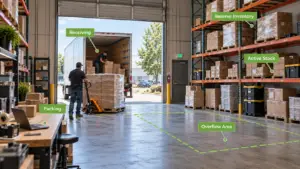
Inside a Houston Bay
What a commercial base actually changes
Three things a residential address can’t give you, no matter how well you organize the garage. Photographed at WorkBay Hempstead in Northwest Houston.
Receiving
Grade level doors and drive in bays mean a supplier truck pulls up and unloads without anyone rearranging a garage first.
Storage and staging
Shelving, racking, and a staging area that stays set up between jobs instead of getting broken down every night.
A front of house
Somewhere to meet a vendor, an inspector, or a customer that isn’t your living room.
Growing Beyond the Garage?
A home address can be exactly right at the start. It gets harder once inventory, equipment, deliveries, and daily operations start growing faster than the house can carry, and at that point a dedicated commercial space separates home life from business operations while giving the company a practical base for receiving, storage, and staging.
Find a WorkBay near your customers
WorkBay has small warehouse spaces across Houston and Dallas Fort Worth built for owners moving the physical side of the business out of the house. Book a tour and bring your list of questions.
This article is general business information, not legal or tax advice. Requirements vary by business activity and location. Confirm current requirements with the relevant Texas agency, your local government, and a qualified professional.
Sources
- Texas Local Government Code § 229.902: Authority to Regulate Home-Based Businesses
This is the primary source for the no-impact home-based business rules, including the occupancy, traffic/parking, visibility, and noise requirements, as well as what cities can and cannot regulate.
Texas Local Government Code § 229.902 - Texas Legislature Online: House Bill 2464
Supports the June 12, 2025 effective date and the legislative change to municipal regulation of home-based businesses.
HB 2464 Bill Summary - Texas Governor’s Office: Business Permit Office
Supports the statement that Texas does not require a general statewide business license and explains that specific industries and activities may still require licenses or permits. It also links to the current Texas Business Licenses & Permits Guide.
Texas Business Permit Office - Texas Secretary of State: Name Filings FAQs
Covers assumed-name requirements, including when sole proprietors and other unincorporated businesses file with county clerks and when filing entities file with the Secretary of State.
Texas Secretary of State Name Filings FAQs - Texas Secretary of State: Registered Agents
Supports the registered-office section, including the requirement for a physical Texas address where the registered agent can receive service during business hours and the rules around mailbox services.
Texas Secretary of State Registered Agents - Texas Secretary of State: Form 503 Assumed Name Certificate Instructions
Supports the distinction between a principal office address and other business addresses and notes that a principal office can use a street or mailing address for this filing.
Form 503 Instructions - Texas Comptroller: Sales and Use Tax Permit FAQs
Supports the sales-tax section, including the requirement for permits at active places of business and the rule that a warehouse is not automatically considered a “place of business” solely because inventory is stored there.
Texas Sales and Use Tax Permit FAQs - City of Austin: Small Business Permitting
Useful as the local example in your article. Austin specifically explains how HB 2464 affects home-based businesses while preserving health, safety, compatibility, and HOA requirements.
Austin Small Business Permitting - City of Houston: About Deed Restrictions
Supports your discussion of residential deed restrictions and how they can limit commercial activity even where the business itself may otherwise be lawful.
Houston Deed Restrictions Guidance